Tuesday, June 14, 2011

Ever Lowering Expectations

After eight years of George W. Bush's assault on not only civil liberty but English language as well, it was reasonably hopeful that we were entering a new era with vast improvement in both fronts.

Well, there were changes for sure and some improvement but not nearly enough.

Not only Guantánamo detention camp is still in full operation, but the assault on English language has changed from mangled words to ignoring the rules of grammar and deliberate twist meanings of phrases.

Obama's biggest offense to date is still his most infamous arm wrestling with the phrase "too... to..." and I wonder if the new generation would ever understand how to use this phrase correctly after his ghastly incorrect way to describe faulting banks in need of bailing out as "too big to fail".

New, a new offense, minor one, admittedly.

Associated Press reported that Obama says he would resign if he were Weiner. San Francisco Chronicle detailed his comments:
President Barack Obama, increasing pressure on Rep. Anthony Weiner to quit, said Monday that "I can tell you that if it was me, I would resign."
I was once again incredulous.  I asked a friend of mine, who graduated from the exalted University of California, Berkeley with English degree and was told that though grammatically speaking, President Obama was wrong.  He should have said "if it were me".  But, according to my friend, that the correct way has been seen as literal, mannered and bookish and colloquially, people usually say it the way President Obama did, the grammatically incorrect way.

I was flabbergasted.  I think there is a debate in the nation regarding the lowered expectation brew generations of lower achievers.

One would hope that a president would have set up a better example.  Is it his hope that by speaking folks' language, therefore, more people would choose him to have beer with?

It is quite disappointing and disconcerting.

The assault on civil liberty and English language has continued.

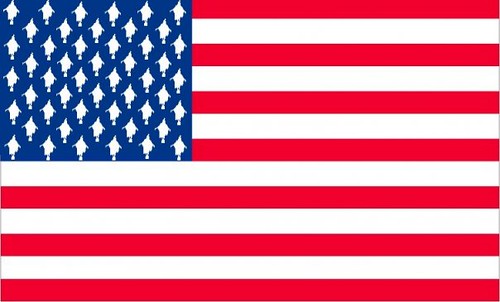
By the way, happy Flag Day.  Or is it Flagellation Day?
n586294159_448808_4915

Friday, June 10, 2011

Circumcision, Female genital mutilation and Abortion

This is getting weirder.  The progressive San Francisco residents are to vote on a measure to make it a misdemeanor to perform circumcision on a male under the age of 18 within the city. Anyone who ignored the ban would face a $1,000 fine and a year in jail.


CBS News reported that:
Circumcision should be outlawed because "it's excruciatingly painful and permanently damaging surgery that's forced on men when they're at their weakest and most vulnerable," a leading proponent of the ban, 59-year-old Lloyd Schofeld, told Reuters.

Since circumcision is a ritual practice for Jews and Muslims, some legal experts say such a ban might prove an unconstitutional infringement of religious freedom, Time reported. But others say religions don't get a "free pass."
People argue against male circumcision like to link it to the female genital mutilation which is more universally condemned in the US.

However, I cannot see male circumcision as on the same level as female genital mutilation, because there are some benefits, however small, of male circumcision in preventing STD and HIV infection, while female genital mutilation does not offer any such benefits and the purpose of female genital mutilation was male control, rather than a covenants between men and creators.

According to World Health Organization (WHO),

Female genital mutilation (FGM) comprises all procedures that involve partial or total removal of the external female genitalia, or other injury to the female genital organs for non-medical reasons.
The practice is mostly carried out by traditional circumcisers, who often play other central roles in communities, such as attending childbirths. Increasingly, however, FGM is being performed by health care providers.

FGM is recognized internationally as a violation of the human rights of girls and women. It reflects deep-rooted inequality between the sexes, and constitutes an extreme form of discrimination against women. It is nearly always carried out on minors and is a violation of the rights of children. The practice also violates a person's rights to health, security and physical integrity, the right to be free from torture and cruel, inhuman or degrading treatment, and the right to life when the procedure results in death.

CBS continued that
The American Academy of Pediatricians says the procedure cuts both ways. In its official policy statement on circumcision - issued in 1999 and reaffirmed in 2005 - the academy said the procedure has potential health benefits, including reduced risk bladder infections and transmission of HIV/AIDs and other sexually transmitted diseases.

But the academy said there were potential downsides to the procedure, pointing to anecdotal reports that circumcision can reduce men's sexual sensation and clear evidence that it can be painful and lead to complications like bleeding and infections - and in rare instances, to partial or complete amputation of the penis.

Given the pros and cons, the academy says "the procedure is not essential to the child's current well-being" and that "parents should determine what is in the best interest of the child."
Care2.com reported that "Jewish groups are objecting to the fact that ritual circumcision of men under the age of 18 would be made illegal, despite the fact that it is, in the words of these San Francisco-area Jewish organizations, "of fundamental importance in the Jewish tradition." Male circumcision is also an important practice in Islam, although it is not compulsory."


Because of the inconclusiveness regarding the benefits of male circumcision and because of the cultural and religious tradition which doesn't involve the repression of a group people, it is hard to argue that government needs to step in the decide for caring parents.

In fact, the arguments the proponents of the male circumcision ban employed were very similar to those abortion opponents.

It is hard to believe that the very progressive San Franciscans would approve government to tell women that they should not have abortion, yet, many of them are poised to enforce a similar ban in the very spirit.


CBS News Image

Thursday, June 2, 2011

Notre Dame University's Quixotic Fight

San Francisco Chronicle recently reported that Notre Dame alone among schools on China goods ban:
Notre Dame's campus bookstore sells "Fighting Irish" lettermen jackets, "ND" license plate frames and stadium cups picturing the school's leprechaun mascot. Not for sale: anything made in China. 

Ten years after adopting the policy, Notre Dame remains the only major U.S. university that forbids license holders such as Adidas to put the school logo on any product from China, according to groups that track college merchandising.

Notre Dame prohibits the goods because China, the top source of U.S. imports, doesn't permit independent labor unions, according to a college policy document. The ban is attracting fresh attention from Washington lawmakers who say China has begun a renewed crackdown on dissidents.

"What Notre Dame is doing is very, very important," Rep. Frank Wolf, R-Va. and chairman of the Appropriations Committee panel that oversees trade, said in an interview. "China is a particularly bad place to do outsourcing, and the American people are totally opposed to it."

While laudable, Notre Dame's policy may not do much to change a country's practices, according to Susan Aaronson, a professor of international trade at George Washington University in Washington. By staking out its own approach, Notre Dame loses the impact of many universities putting collective pressure on suppliers, she said.

"You have to have enough demanders of good labor protections," Aaronson, who writes about China and labor rights, said in an interview. Notre Dame's ban, she said, "is not a mistake, but it is likely to have little impact on behavior in China."

Sadly, I had agree that Notre Dame's ban itself, might not do much alone.  However, it should be an example for people to follow.  Anyone who uses an iPhone or an iPad ought to know the miserable working conditions the assembling line workers in Foxconn in China.

US and Americans are proud of our idealism and it will be up to every single one of us to demand our profit seeking companies to ensure the humane working conditions in factories working for our benefits.

Eternity - Four Seasons / 永恆 - 四季 / Ewigkeit - vier Jahreszeiten
Eternity - Four Seasons © Matthew Felix Sun

Tuesday, May 31, 2011

"Not Armageddon But One Crisis After Another" - David Alan Stockman

The economic situation in the US is still precarious and the debt ceiling debate did not generate the debate we truly need at this crucial juncture.  True, we need to rein in spending, but not (only) the entitlement programs, and spending on military, on big business subsidies and tax giving away to the rich.

Interestingly, an insider of Regan's administration, generally viewed as conservative and anti-tax wing, provided some insightful and pertinent solutions.  If only half of his proposal got seriously debated, this country would have a chance to correct its course.  But that is not going to happen soon.

San Francisco Chronicle reported that David Alan Stockman, director of the Office of Management and Budget in the Reagan administration, sat down to discuss the federal debt and the economy.  The summary of his analyses is:
I think we have an economy today that's on the edge of insolvency. We'll be dealing with an age of sacrifice, austerity and an age of pain. You have to stop pretending that we're in a normal business cycle.
The Republicans are just focusing on tax cuts while Democrats are defending their spending and they aren't willing to compromise. You're going to need to allow the Bush tax cuts to expire and, on top of that, find some new revenue sources. The Republican Party is being reckless in historic proportions, reckless to the extreme.
Obama's got to stop talking about taxing only the top 2 percent. Tax increases are going to have to include the middle class.

The politicians have had their head in the sand for so long about this issue that I really don't think they can compute reality anymore.
We need a drastic downsizing of our war machine, especially after they got Osama bin Laden. We should be rethinking whether we need an $800 billion defense budget. That's a vital part of the equation.

In a pure world, I think you could cut a lot of spending. There would be a way of getting back to a government where we do a social safety net on a means-tested basis, but that is never going to happen in this world.

Revenue is absolutely necessary, both as a practical matter and a matter of numbers. We should put a variable levy on imported oil at $100 (a barrel); whatever the price is coming in, you pay a levy to bring it to $100. We increase the power of the economy, both supply-side and demand-side, if we give investors a certainty of the price.

If we have a Tobin tax - a small tax on every transaction in this casino we used to call the stock market - we can easily generate $100 billion in revenue. We have a massive high-frequency churning in these markets today, and they're not accomplishing anything that's productive for the rejuvenation of the private economy.

We don't have entrepreneurial capitalism anymore, we have crony capitalism. We've had a tremendous reverse Robin Hood redistribution of income to the top. I don't think it's Armageddon. I think it's just one crisis after another.
Though I cannot say I agree with him point to point, most of his analyses are right on target and would lead to a fairer, more sustainable society.

He doesn't have nice things to say about the Democrats but he reserved most severe criticism on the Republicans.  Would they listen?  I'm not optimistic.  This country is heading towards precipice and it would be a miracle to stop the suicidal madness.

At Home / 安逸 / Bequem
At Home © Matthew Felix Sun

Thursday, May 19, 2011

Ever Lowering Higher Education

Graduation time.   It is easy to be carried away by the exciting events and the glowing faces of those young men and women who had just earned their degrees and diplomas.

Yet, behind this cheerful and happy veneer, something deeply disturbing is lurking.

Richard Arum and Josipa Roksa published in New York Times a somber article, Your So-Called Education, which was enough to make people sleepless, if they care about the future of this once great country.  Below are some paragraphs from the article:

We would be happy to join in the celebrations if it weren’t for our recent research, which raises doubts about the quality of undergraduate learning in the United States. Over four years, we followed the progress of several thousand students in more than two dozen diverse four-year colleges and universities. We found that large numbers of the students were making their way through college with minimal exposure to rigorous coursework, only a modest investment of effort and little or no meaningful improvement in skills like writing and reasoning.

In a typical semester, for instance, 32 percent of the students did not take a single course with more than 40 pages of reading per week, and 50 percent did not take any course requiring more than 20 pages of writing over the semester. The average student spent only about 12 to 13 hours per week studying — about half the time a full-time college student in 1960 spent studying, according to the labor economists Philip S. Babcock and Mindy S. Marks.

Not surprisingly, a large number of the students showed no significant progress on tests of critical thinking, complex reasoning and writing that were administered when they began college and then again at the ends of their sophomore and senior years. If the test that we used were scaled on a traditional 0-to-100 point range, 45 percent of the students would not have demonstrated gains of even one point over the first two years of college, and 36 percent would not have shown such gains over four years of college.


While some colleges are starved for resources, for many others it’s not for lack of money. Even at those colleges where for the past several decades tuition has far outpaced the rate of inflation, students are taught by fewer full-time tenured faculty members while being looked after by a greatly expanded number of counselors who serve an array of social and personal needs. At the same time, many schools are investing in deluxe dormitory rooms, elaborate student centers and expensive gyms. Simply put: academic investments are a lower priority.

The situation reflects a larger cultural change in the relationship between students and colleges. The authority of educators has diminished, and students are increasingly thought of, by themselves and their colleges, as “clients” or “consumers.” When 18-year-olds are emboldened to see themselves in this manner, many look for ways to attain an educational credential effortlessly and comfortably. And they are catered to accordingly. The customer is always right.

Others involved in education can help, too. College trustees, instead of worrying primarily about institutional rankings and fiscal concerns, could hold administrators accountable for assessing and improving learning. Alumni as well as parents and students on college tours could ignore institutional facades and focus on educational substance. And the Department of Education could make available nationally representative longitudinal data on undergraduate learning outcomes for research purposes, as it has been doing for decades for primary and secondary education.
The decline of the education is the U.S. is obvious to most and it will go lower, considering in this country, people only have eyes and ears for celebrities or virtual television shows, plus the daily intellect bashing from certain political sectors, the trend will continue in long stride.

Yet, people are less concerned and worried than they ought to be.

Read another article on New York Times, Major Delusions, by Tali Sharot:
THIS month American college seniors will don caps and gowns. As they await receipt of their diplomas, they will absorb lessons handed to them by the accomplished men and women who deliver commencement speeches. More often than not the speakers will be outliers: rare individuals who made it against all odds. More often than not their message will be "dreams come true ... take chances ... if you try hard enough you will succeed."
"Don't know that you can't fly, and you will soar like an eagle," Earl E. Bakken, founder of the medical technology company Medtronic, told the University of Hawaii's class of 2004. "You have to trust that the dots will somehow connect in your future," Steven P. Jobs told Stanford's 2005 graduates.

For many years, scientists were puzzled by the existence of this unshakable optimism. It did not make sense. How is it that people remain optimistic even though information challenging those predictions is abundantly available? It turns out it is not commencement speeches or self-help books that make us hopeful. Recently, with the development of non-invasive brain imaging techniques, we have gathered evidence that suggests our brains are hard-wired to be unrealistically optimistic. When we learn what the future may hold, our neurons efficiently encode unexpectedly good information, but fail to incorporate information that is unexpectedly bad.

That's why when we listen to Oprah Winfrey’s rags-to-riches story our brain takes note and concludes that we too may become immensely rich and powerful one day; but when told the likelihood of being unemployed is almost 1 in 10 or of suffering from cancer is over 1 in 3 we take no notice.

In some cases relatively minor biases can even lead to global disaster. Take the financial crisis of 2008. Each investor, homeowner, banker or economic regulator expected slightly better profits than were realistically warranted. On its own, each bias would not have created huge losses. Yet when combined in one market they produced a giant financial bubble that did just that.

As the Duke economists Manju Puri and David T. Robinson suggest, optimism is like red wine: a glass a day is good for you, but a bottle a day can be hazardous. The optimal solution then? Believe you will live a long healthy life, but go for frequent medical screenings. Aspire to write the next "Harry Potter" series, but have a safety net in place too.

At a time when the economic crisis is deepened by revolutions and tsunamis, cautious optimism may be the most useful message to communicate to graduates — believe you can fly, with a parachute attached, and you will soar like an eagle.
I got it.  We cannot let despair to bog us down.  But the relentless cheerfulness so perversely prevailing in the American culture was the engine to push or pull this country ahead.  However, it did not act alone.  It was coupled with solid public educational system in past decades.

With the demise of those superb public school in the nation, cheerfulness can only take you few steps, but never far.

Matthew Felix Sun's Drawing_7231

Monday, May 16, 2011

When Means Become Ends

Taxing cutting oriented political and business leaders insisted on that it is necessary to cut taxes when the economy is doing well, because of the "need to return the money to the people", and cut taxes even more then economy is rocky, in order to "spur the growth".

They, somehow, deliberately or not, ignored the disconnection between economic growth and the real living standards of average Joes and Janes.

The mantra that development and growth is paramount, most ardently propagandized by authoritarian Chinese government has a huge market here, it seems.  However, we must ask what is the purpose of all those glittering growth?

Growth and development are the means to improve people's life, spiritually and materially.  Failing that, what are the points of those growth and development?

When means becomes ends, we know that something is not right and must be corrected.

But we won't hear that from the Republican leaders, and the Democrat leaders are too cowardly to speak on this issue.

Dare we hope?  Nein.

Domesticity / 家居 / Häuslichkeit
Domesticity by Matthew Felix Sun

Monday, May 9, 2011

Mankind Must Triumph Over Nature?

San Francisco Chronicle reported in Delta plan blasted over omissions by U.S. panel reported that
A widely watched plan for the Sacramento-San Joaquin River Delta that purports to both revive collapsing fish species and ensure stable water supplies instead reads as a crude justification for a controversial 40-mile pipeline around the estuary, a panel of pre-eminent scientists convened by the Obama administration said Thursday.

What's more, after four years and $150 million, the draft plan has failed to define basic goals or analyze the potential impacts on the sensitive and failing ecosystem at the core of California's water system, according to the National Research Council, the research arm of the influential National Academy of Sciences.

The so-called Bay Delta Conservation Plan, the result of a collaboration of state, federal and local water agencies, is supposed to be a blueprint for the future of the delta, and its recommendations on building a peripheral canal or other water conveyance system are expected to be adopted by the state.

On Thursday, however, an esteemed group of biologists, engineers, hydrologists and legal scholars scolded the collaborators for their lack of scientific rigor and accused them of steering the outcome toward a contentious canal. California voters rejected a similar proposal in 1982, calling it a blatant water grab of Northern California's waters by Southern California interests.
In regardless if this is a blatant water grab or not, this project reeks the stench of Maoist slogan - Mankind Must Triumph Over Nature.

Engineers love to design and contractors love to build.  That's what they are trained to and that's how they make living and get rich.

However, try to build a canal or pipeline which would affect a great area and might jeopardize vulnerable fish and plant life is something we should not proceed unless we are sure of the impact.  But the study seemed like the rubber stamp People's Congress in China, which approved even more ambitious water projects - the finished Three Gorge Dam and the on-going South–North Water Transfer Project, which would be even more disruptive and more damaging than the Three Gorge Dam.  The only people who would benefit from such enormous endeavors are contractors and corrupt officials.

The Three Gorge Dam was approved in the assumption that water level would remain the same upstream and downstream, even in flooding season, therefore artificially reduced the number of people needed to be relocated.  Last year, after multiple attempts, they finally brought the water level behind the dam to the designed 175 meter and recently they had to reduced it to 162 meter, so as to "ensure the safety the the navigation downstream". 

The South–North Water Transfer Project would be just irresponsible and insane.

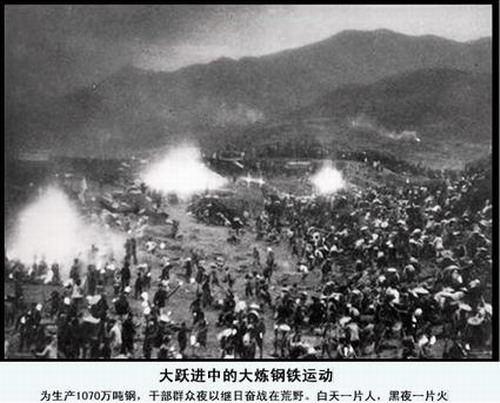
The spirit of "Mankind Must Triumph Over Nature" reached its zenith in 1950s during Great Leap Forward campaign, when science was make whore of politics.  Now, our country is eager to learn from China, our great creditor and competitor.  Mao makes a comeback in China and with the increasing influence of China, he will lead us move forward just as mightily.  If we cannot win in manufacture, science, and education, at least we can catch up with them in our determination to triumph over nature. 


During Great Leap Forward period (1958-61), Chinese people in the countryside working at night to produce steel.